
Patents for June/July 2026
Patents for the Fastener Industry as compiled by the editors of FTI from the United States Patent and Trademark Office (USPTO) at www.uspto.gov
Screw with Separate Thread Helix and Integral Thread Start
US Patent 12624721
Published May 12, 2026
Inventors: Roland Schneider, Schlins, Austria; Florian Zielbauer, Rüthi, Switzerland; Christian Gebauer, Altstätten, Switzerland; and Guenter Domani, Weissensberg, Germany
Assignee: Hilti AG, Schaan, Liechtenstein
A screw including a shank having a tip end and a rear end, which is located opposite the tip end, and at least one screw thread, which is arranged on the shank, which winds around the shank and which protrudes from the shank, wherein the screw thread includes a separate screw thread section, which is constituted by a separate helix element that is non-monolithically arranged on the shank. The at least one screw thread includes a thread start, which extends further towards the tip end than does the separate screw thread section, and which forms a generally helical continuation of the separate screw thread section, wherein the thread start and the shank are monolithic.
Threaded Fastener, and Function Addition Member of Threaded Fastener
US Patent 12624759
Published May 12, 2026
Inventor: Youichi Matsueda, Hadano, Japan
Assignee: Topura Co., Ltd., Hadano, Japan
To provide a screwing fastener that is capable of preventing damage to a function adding member when tightening and is capable of maintaining suitable functions of the function adding member and a suitable fastened state. A screwing fastener includes a fastener main body 10, a screw portion 13 for tightening the fastener main body 10 to a fastened member 200, a flange portion 14 provided to the fastener main body 10 and a seal function adding member 20 (function adding member) that is provided to the flange portion 14, in which the seal function adding member 20 comes into contact with the fastened member when tightening. The seal function adding member 20 has at least a two-layer structure of a sliding portion 22 (first adding portion) that is in contact with the flange portion 14 and a seal portion 21 (second adding portion) that comes into contact with the fastened member 200.
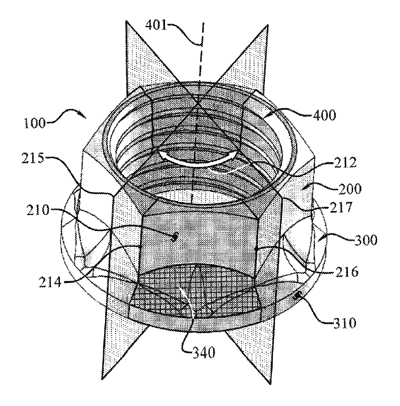
Enhanced Flange Nut
US Patent 12624720
Published May 12, 2026
Inventor: Raymond Disantis, Willoughby Hills, OH, USA
Assignee: BPC LG 2, LLC, Charlotte, NC, USA
A nut allowing selective removal of nut material in very specific areas through the use of unusual curvatures and relationships, thereby providing enhanced durability, toughness, resilience to shock and ability to accept elastic strain, while providing improved stress distribution, increased strength and resistance to nut dilation. Features of the nut flange and nut transition area, specifically unique combination of radii of curvature and the placement the curved surfaces, between the planar surfaces of tool engagement surfaces and the flange seat provide enhanced performance.
Spacer Nut
US Patent 12624722
Published May 12, 2026
Inventor: John Weiss, San Francisco, CA, USA
Assignee: The Boom, San Francisco, CA, USA
Disclosed embodiments include spacer nuts for use with battery packs and configurations thereof.
Eccentric Bolt for Attaching Mission Pod to Aircraft
US Patent 12618429
Published May 5, 2026
Inventor: Thomas J. Harleman, Maple Valley, WA, USA
Assignee: The Boeing Company, Arlington, VA, USA
Systems and methods are provided for eccentric bolt. One embodiment is an eccentric bolt to secure a clevis and lug fitting. The eccentric bolt includes a head and a shank. The shank includes multiple shank sections that successively decrease in diameter in an axial direction from the head toward a tail end of the shank. One of the shank sections is an eccentric shank section that is off-center with respect to a center axis of the shank. The eccentric shank section is configured to engage the lug prior to engagement of concentric shank sections with the clevis. While the eccentric shank section is engaged with the lug, the shank is configured to rotate to align the concentric shank sections with the clevis, and to insert through the clevis and lug fitting to compensate for misalignment of the clevis and lug fitting.
Two-Piece High-Strength Screw
US Patent 12612936
Published April 28, 2026
Inventors: Manuel Kellner, Alsfeld-Altenburg, Germany; Thorsten Schmitt, Laubach, Germany; and Stefan Wallmeier, Goldbach, Germany
Assignee: KAMAX Holding GmbH & Co. KG, Homberg, Germany
High-strength screw (1), with a head (2) with a tool engagement contour (4), a shank (3) with a free end (5) pointing away from the head (2), a threaded section (6) with a thread (7) being arranged on the shank (3), the thread (7) being formed as a metric ISO thread or inch thread, the head (2) and the shank (3) being de-signed as materially separate parts, the head (2) having a coupling recess (8) arranged radially inside with an axial force transmission element (9) and a torque transmission element (10), the shank (3) having a coupling element (11) arranged radially outside on its outer circumference with an axial force transmission counter element (12) and a torque transmission counter element (13), the coupling element (11) engaging in the coupling recess (8), the axial force transmission element (9) and the axial force transmission counter element (12) being designed and arranged to positively interlock in such a way that an axial translatory movement of the head (2) relative to the shank (3) in the direction away from the free end (5) of the shank (3) is prevented or will be prevented, in particular non-releasably, and the torque transmission element (10) and the torque transmission counter element (13) being designed and arranged to interlock in such a way that a rotational movement of the head (2) relative to the shank (3) in the tightening direction of the thread (7) is or will be prevented.
Fitting with Ring Nut for Fixing a Branch Pipe of an Irrigation System
US Patent 12601439
Published April 14, 2026
Inventor: Cosimo Iacopetta, Bisceglie, Italy
Assignee: Teco Srl, Trani, Italy
An internally hollow fitting for the passage of a liquid, in particular water, with a component to restrain unmovably a pipe of an irrigation system, wherein the restraining component of the pipe is carried by a ring nut screwing on an external thread of the at least one end of the fitting.
Fluid Tight Blind Fasteners and Methods for Fastening
US Patent 12601366
Published April 14, 2026
Inventors: Luke L. Haylock, Culver City, CA, USA; Todd A. Balls, Tucson, AZ, USA; and Junjie Huang, San Gabriel, CA, USA
Assignee: Howmet Aerospace Inc., Pittsburgh, PA, USA
Fluid tight blind fasteners and methods for fastening are provided. The sleeve comprises a first sleeve end comprising a first inner surface, a second sleeve end comprising a second inner surface, and an elongate portion extending from the first sleeve end to the second sleeve end. The first inner surface and the second inner surface define a sleeve cavity extending into the sleeve from the first sleeve end toward or to the second sleeve end. The pin is configured to be at least partially received by the sleeve cavity. The pin comprises a first pin end portion configured to receive a torque, a second pin end and a shank extending from the first pin end portion to the second pin end. Tire shank comprises threads and the threads are configured to form threads on the second inner surface of the sleeve.
Sealing Wall Fastener Assembly
US Patent 12595653
Published April 7, 2026
Inventors: Jason R. Wigboldy, Grand Rapids, MI, USA; Mitchell B. Mahler, Grand Rapids, MI, USA; and David A. Boyd, Grand Rapids, MI, USA
Assignee: Altenloh, Brinck & Co. US, Inc., Bryan, OH, USA
A wall fastener assembly for retaining an attachment such as a girt alongside or near a wall includes an elongated shank that provides space for at least one intermediate wall layer between the girt and a supportive member such as a stud. A center bore extends through the wall fastener assembly, and may receive a fastener for securing the wall fastener assembly to the wall. Once the wall fastener assembly is secured to the wall, a proximally-located flange and a distal end of the shank bottom-out on different surfaces to ensure the attachment is properly mounted to the wall and a distally-located sealing portion engages with an intermediate wall layer to form a fluid barrier within the wall.